Oct 31 2010
It’s A GOP Tsunami, And It is Enormous!

Last week I predicted around a 75 house seat pick up for the GOP, along with a 9-11 senate seat win (you can’t win 75 seats in the house and not tip the Senate). I may have underestimated what is coming on November 2nd.
Gallup is out with it’s generic voter results for the final week leading into the elections, and it is historic (click to enlarge):

The results are from Gallup’s Oct. 28-31 survey of 1,539 likely voters. It finds 52% to 55% of likely voters preferring the Republican candidate and 40% to 42% for the Democratic candidate on the national generic ballot — depending on turnout assumptions. Gallup’s analysis of several indicators of voter turnout from the weekend poll suggests turnout will be slightly higher than in recent years, at 45%. This would give the Republicans a 55% to 40% lead on the generic ballot, with 5% undecided.
…
Taking Gallup’s final survey’s margin of error into account, the historical model predicts that the Republicans could gain anywhere from 60 seats on up, with gains well beyond that possible.
It should be noted, however, that this year’s 15-point gap in favor of the Republican candidates among likely voters is unprecedented in Gallup polling and could result in the largest Republican margin in House voting in several generations. This means that seat projections have moved into uncharted territory, in which past relationships between the national two-party vote and the number of seats won may not be maintained.
We are in uncharted territory. That is the reality of this election cycle.
The Democrats had no clue what would happen if they arrogantly ignored the wishes of the center of the electorate. Focused on their arch enemies on the far right, the liberal Democrat leadership in DC just assumed they would be determined to be the better of two evils. They were seriously wrong. So wrong they have created a backlash of biblical proportions – and destroyed any future consideration of liberal or far left policy proposals.
Nate Silver has an interesting scenario, where he describes the Wednesday after the election in what may be a truly prescient vision:
Not only did Republicans take over the House, but they also did so going away — winning a net of 78 seats from Democrats. Seven seats in New York State changed hands; so did six in Pennsylvania, five in Ohio and four in North Carolina. Party luminaries like Jim Obertsar and Raul Grijalva were defeated. Barney Frank and Dennis Kucinich survived, but they did so by just 2 points apiece, and their elections weren’t called until 1 a.m. Democrats picked up just one Republican-held seat — the open seat in Delaware — but Joseph Cao somehow survived in his very Democratic-leaning district in New Orleans. Virtually every race deemed to be a tossup broke to the Republican.
The news isn’t much better in the Senate. The Democratic candidates in North Dakota, Arkansas, Indiana, Wisconsin, Pennsylvania, Colorado and Illinois all lost, flipping those seats to red from blue. So did Harry Reid in Nevada and Joe Manchin in West Virginia; both of them lost by 7 points, in fact. Washington State isn’t finished counting its ballots, but Dino Rossi has about a 30,000-vote lead over Patty Murray, and looks likely to prevail. California isn’t done counting either, and the race between Barbara Boxer and Carly Firoina remains too close to call. It might not matter anyway: Joseph I. Lieberman has scheduled a press conference for later that afternoon, and is expected to announce that — after seeing the strength of the mandate the voters have given the G.O.P. — he’ll begin conferencing with Republicans when Congress reconvenes in January.
What Nate is describing is a statistically possible outcome assuming we get the 5%, once in a century election cycle. Gallup’s once in a century results seem to indicate that is where we are heading. I have been expecting this for a while. I have seen incredible House trends in RCP’s election data. I have seen a single polls swing 15% points towards the GOP in the last week. One example is ME-2, another is NV-3. There are a lot of these shifts in all corners of the nation. This means a wave – a really big wave.
I have also seen this blow out in early voting trends, such as we see in PA:

If we assume the GOP will lead with independents 60-40% (a well established trend in many national and state-wide polls), and the Dems lose 15% of their base while the GOP only loses 5%, then PA would see a the GOP win the early vote by 23.5% (61.8%-38.2%). That would be one helluva wave out there to sweep across PA if the GOP was winning generally by 20+% in PA.
I could envision waking up on Wednesday to find only 1-2 Democrat Congressman left standing in VA (Bobby Scott for sure, and maybe Jim Moran). It is that bad out there.
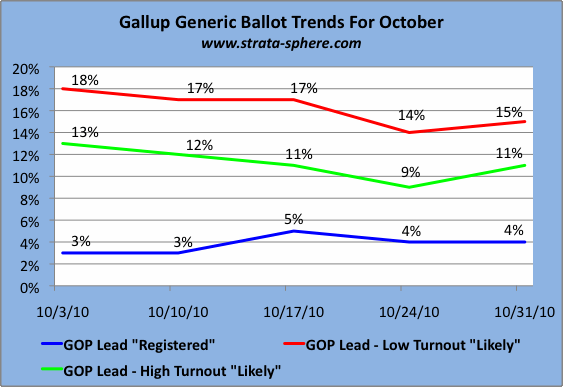
Let’s get back to those stunning Gallup numbers and look at the ‘trajectory’ over the last month. The GOP lead was shrinking for a while giving the impression the Dems may stave off some of the damage. But the last week proves that whatever the source of that hesitation to throw the Democrats out is now gone. The last trend sees movement back to a GOP landslide (click to enlarge):
A more interesting way to look at this data is to see how the Democrat and GOP generic lead will fall into two distinct bands come Tuesday:
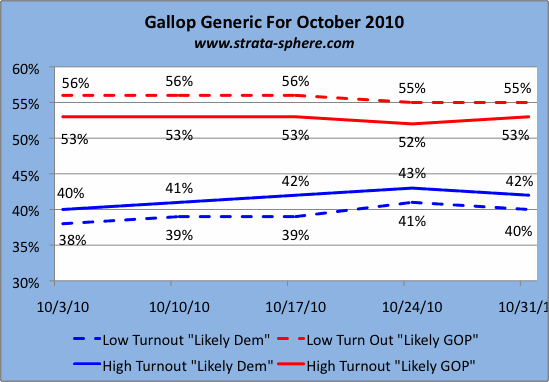
Here we see how where the GOP edge will fall (inside the two red lines) verses the Democrat range (the two blue lines). Whether one uses the high or low turnout models from Gallup, the news is really bad for the Democrats.
Gallup also notes and ever expanding GOP lead with independents. They show something on the order of a 30% lead for the GOP with independents, which if true will be why so many races fall to the GOP that no one expected (think CA and WA for sure):
Ninety-two percent of Democrats are voting for the Democratic candidate in their district, and 96% of Republican likely voters are voting for the Republican candidate. Independents tilt toward the Republican candidate by a sizable 59% to 31% margin.
This 30% lead with independents is larger than anything I have seen from Gallup. When I recently computed early voting theoretical results I always assumed 20%. This alone would tilt a lot of state-wide races into the GOP column. But I do not see how you lose 30% of the center and also not lose a lot of the Democrat base that exists near the center. There is no way the center left dems are staying with the Democrat party 96-4%. In those previous calculations I ran scenarios assuming a 15% loss of the Dem party voters (a small amount). That pretty much threw the Dems out on their ears everywhere – and then some.
With these new numbers I am very confident in my previous predictions of a GOP gain of 70-80 house seats and 9-11 senate seats. If anything I would increase my senate prediction to 10-11 seats, confirming a GOP take over of both house of Congress.
This is what happens when the hyper-partisans on the fringe 20% piss off the rest of the country – you get these kinds of results. A huge warning for the GOP, Tea Party and conservative movement. A harsh but well earned lesson for the far left.
Update: Trying to get your mind wrapped around these numbers is not easy. Here is the Weekly Standard’s Sunday night attempt.